A Critical Linux Vulnerability Shows Why Virtualization Remains Essential for Multi-Tenant Security
CVE-2026-31431 highlights the risks of shared kernels and reinforces the importance of strong isolation
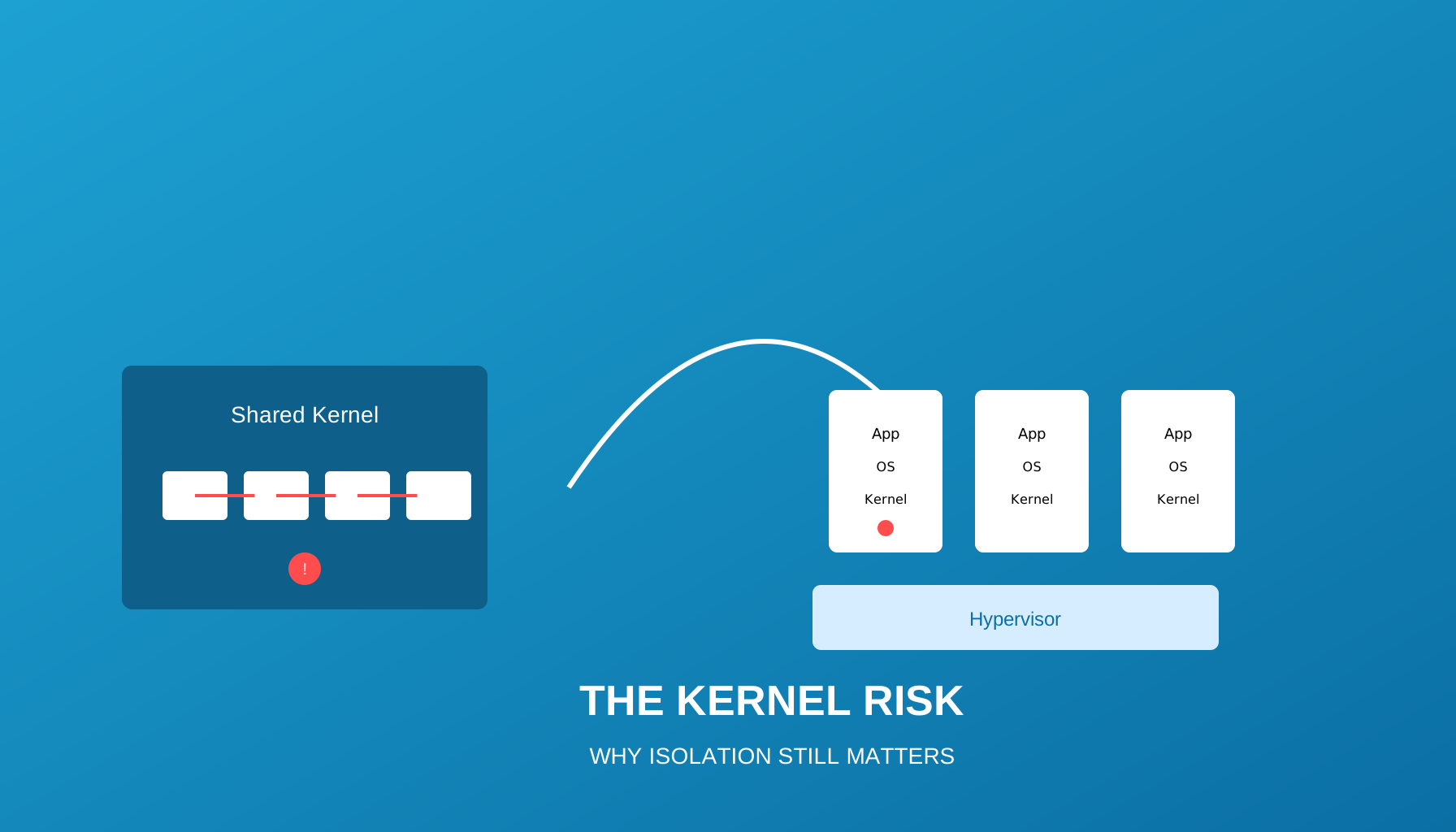
A recently disclosed vulnerability — CVE-2026-31431 (“Copy Fail”) — allows an unprivileged user to gain root access on nearly every major Linux distribution.
- No race conditions
- No distro-specific offsets
- No version checks
- Close to a 100% success rate
This is not just another kernel bug.
It is a reminder of something fundamental in modern infrastructure design:
If you share a kernel, you share the risk.
What makes this vulnerability different?
This exploit targets the Linux page cache, corrupting memory without touching disk.
That means:
- File integrity tools won’t detect it
- Disk images won’t show compromise
- The attack lives entirely in memory
But the most important aspect is this:
The page cache is shared across all workloads on a host — including containers.
In practical terms:
One compromised container can take over the entire node.
Containers are not a security boundary
Containers are often misunderstood as lightweight virtual machines.
They are not.
Containers share:
- The same kernel
- The same memory management primitives
- The same underlying trust boundary
This works incredibly well for:
- Efficiency
- Scalability
- Developer velocity
But from a security perspective, it introduces a critical trade-off:
Isolation is only as strong as the shared kernel.
When the kernel is compromised, all workloads are exposed.
The Kubernetes misconception
Kubernetes is an orchestration platform — not a security boundary.
It is designed to:
- Schedule workloads
- Manage lifecycle
- Scale applications
It is not designed to isolate mutually untrusted tenants at the kernel level.
Yet many modern platforms attempt exactly that: running multiple customers on shared Kubernetes nodes.
CVE-2026-31431 shows how fragile that assumption can be.
Why whitesky.cloud chooses virtualization
At whitesky.cloud, we take a different approach.
We use virtualization as the foundation for multi-tenant environments.
This changes the security model completely.
With virtualization:
- Each tenant runs its own kernel
- Memory is isolated by the hypervisor
- A compromise is contained within a single VM
Even if an attacker gains full root access inside a VM:
They do not gain access to other tenants.
This is not a software convention.
This is hardware-enforced isolation.
Multi-tenancy is a security problem
Running multiple customers on the same hardware is not just about efficiency.
It’s about trust boundaries.
If workloads share a kernel, you are implicitly assuming:
“Every tenant is equally trusted.”
In real-world environments — especially:
- MSP platforms
- SaaS providers
- Government or sovereign cloud
That assumption does not hold.
The takeaway
CVE-2026-31431 is not just a vulnerability.
It is a case study in architectural risk.
- Containers are powerful
- Kubernetes is essential
- But neither replaces strong isolation
Virtualization remains the most reliable way to enforce tenant isolation.
At whitesky.cloud, we don’t see virtualization as legacy.
We see it as:
Engineered isolation — by design, not by assumption.
Final note
If you are running Linux infrastructure — patch immediately.
If you are running multi-tenant platforms — reconsider your isolation model.
Because when the kernel fails…
everything that depends on it fails with it.
Related Articles
January 28, 2026
VDI support, backup management, external authentication, vTPM with secure boot, and Kubernetes …
Simplify Your Kubernetes Journey with mogenius
November 19, 2025
Experience a seamless transition to cloud-native IT environments. mogenius fully automates the …

Dutch Sovereign Cloud Platform Reaches 99.999% Uptime
December 3, 2025
Varity and whitesky.cloud jointly demonstrate that American hyperscalers are not required for …