Cloud Enablers and Virtual Cloud Operators: The Telecom Wholesale Model Comes to Cloud Infrastructure
The Article That Said More Than It Meant
When Light Reading published its feature on whitesky last October, the headline said “Belgian startup aims to take on VMware.” It described a tier-1 deployment at América Móvil. It discussed open-source stacks, edge computing, and European sovereignty.
All of that is true. But it only tells half the story.
The deeper truth is this: whitesky didn’t invent a new model. We borrowed one. We looked at how the telecom industry has structured wholesale infrastructure for 30 years — MVNE, MVNO, roaming agreements, interconnection — and we applied it to cloud computing.
MVNO to VCO: A Straightforward Translation
In telecommunications, the model is well established. An MVNE (Mobile Virtual Network Enabler) provides the technical platform — billing, provisioning, and core network services — that allows an MVNO to operate under its own brand, without needing to build its own infrastructure. The physical network (towers, spectrum, radio access) remains with the host MNO (Mobile Network Operator). An MVNO (Mobile Virtual Network Operator) doesn’t own any of that. It focuses on customer relationships, branding, managed services, and packaging network capacity for specific market segments.
Cloud computing has never worked this way. Until now.
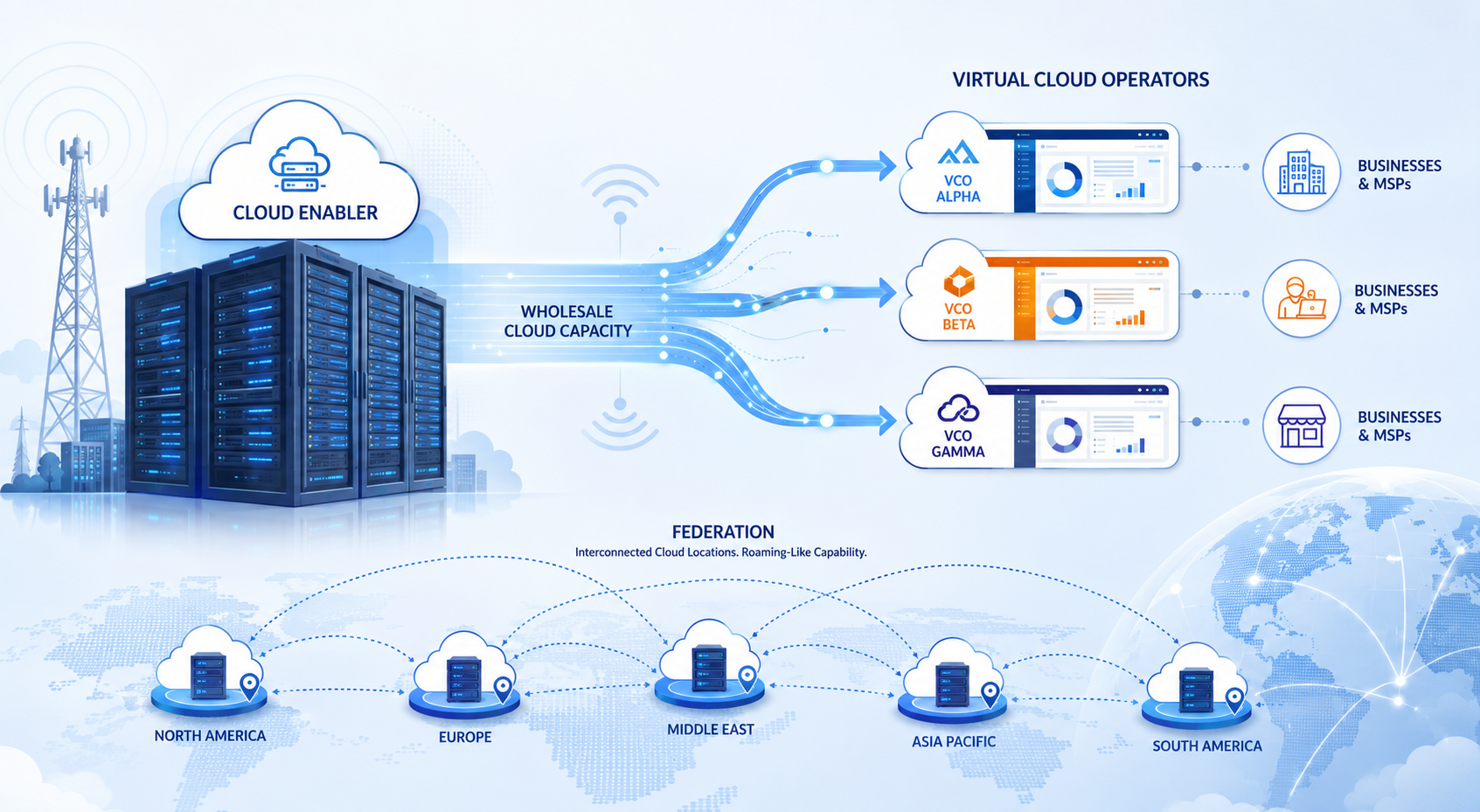
A Cloud Enabler owns physical infrastructure — servers, storage, datacenters, connectivity — and hosts the whitesky cloud platform, which whitesky.cloud operates as a managed service. A Virtual Cloud Operator (VCO) buys wholesale cloud capacity and resells it under its own brand, with its own pricing, its own SLAs, its own managed services. No servers, no datacenter footprint, no platform complexity. The same business model, the same risk distribution, the same market access.
The telcos are the natural anchor on the Cloud Enabler side. Tier-1 and regional operators already have the facilities, the capital, the regulatory standing and the customer base that give a sovereign cloud grid scale and credibility — exactly as they once did for mobile networks.
The Roaming Parallel: Capacity Without Borders
The analogy goes deeper. In telecom, roaming means a subscriber on one network can use services on another network anywhere in the world. The visited network bills the subscriber’s home network, which bills the subscriber. Settlement is standardized, metering is automatic, and trust between operators is mediated by well-understood commercial and technical agreements.
This is exactly what the whitesky Federation enables.
Each Cloud Enabler owns its own whitesky cloud location. Each location is isolated, sovereign, and locally controlled. But through the Federation, a VCO in Kampala can spin up workloads in Brussels. A Cloud Enabler with surplus capacity can sell it to a partner in another country. A SaaS company can burst from its primary location into a federated cloud on the other side of the world.
“It would be similar if AWS was reselling Google Cloud capacity to its customers. But that’s not the case. They are silos and not built for interoperability.”
This is what we told Iain Morris at Light Reading. The hyperscalers are brilliant at building their own clouds. They are not built for interconnection. Their model is consolidation, not federation. We built the roaming protocol for cloud.
Why Now? Sovereignty, Economics, and the Hyperscaler Hangover
Telecom went down this path for a reason: no single operator can build everywhere, serve every market segment, or afford the capital expenditure of universal coverage. The wholesale model made telecom accessible to hundreds of players who couldn’t afford to build their own networks.
Cloud computing is hitting the same constraints. Organizations don’t just need compute — they need local presence, data residency, sovereignty compliance, predictable costs, and vendor independence. The hyperscalers offer scale, but they don’t offer control. Even their own “sovereign” offerings leave ultimate ownership and jurisdiction American — sovereignty by permission, not sovereignty by design. You can run anywhere in their cloud, but you can’t run on your own terms.
Meanwhile, Broadcom’s acquisition of VMware has triggered license increases reported at 400% and beyond, forced subscriptions and partner cuts — a mass migration event. Organizations that built on VMware are discovering that replacement doesn’t have to mean going to another big vendor. It can mean going to a locally controlled cloud location, owned by a partner who understands the market, built on open standards, and connected to a global Federation.
Varity in the Netherlands illustrates the model precisely. Rather than reselling someone else’s hyperscaler, Varity owns its own whitesky cloud location — acting as a Cloud Enabler to serve customers directly through its branded portal, and enabling other VCOs to resell whitesky cloud capacity under their own brands. A sovereign cloud provider in its own right, where partners can offer open-source ERP, CRM and other IT software to local businesses. That’s the MVNO playbook applied to cloud infrastructure.
The Federation Is the Interconnection
In telecom, interconnection between networks created global coverage without requiring any single operator to build globally. The whitesky Federation does the same for cloud. Today the platform runs in live operation for around 50 partners, VCOs and end customers, across 18 cloud locations in 8 countries on three continents — Europe, Africa and the Americas. 10 of them are in the Federation, each offering capacity that any other participant can use; the others are private, single-tenant clouds.
This isn’t just a technical architecture. It’s a commercial ecosystem. Each Cloud Enabler sets its own pricing for its local capacity. The Federation handles cross-location metering, settlement, and billing. A VCO can buy capacity in Kampala, Brussels, and Mauritius from a single portal, with a single invoice, backed by a single platform.
The “simple unit” that makes this work is the billing denominator Hans van Linschoten, our co-founder, described in the Light Reading article — a common measure for compute, memory, and storage that lets all participants trade capacity fairly. Without that, Federation billing would collapse into bilateral nightmares. With it, capacity becomes a commodity that flows to where it’s needed.
This is the same logic that built the submarine-cable consortia — 2Africa, EllaLink, Equiano: infrastructure too strategic for any one player to own alone, operated collectively. Applied to sovereign cloud, where the network effects are stronger, it positions the Federation at the center of a multilateral, telco-led ecosystem rather than as one more vendor.
That same spirit of collective, open European infrastructure is why whitesky is becoming a member of Project Sylva, the open-source telco-cloud initiative hosted at Linux Foundation Europe. Sylva has done the hard, shared work of standardizing the cloud-native foundation for network functions across the region’s operators. We want to add our capabilities to the Sylva project and its members, and we intend to learn from the members to enhance our own platform and services to add to the overall vision and purpose. The wholesale operator layer, the Federation and the sovereign-AI capabilities described here sit on top of — and are complementary to — that foundation. MVNO-style economics work best on open, shared standards, and that is exactly what the Sylva community is building.
What This Means for MSPs
The managed service provider segment is fragmenting — and consolidating at the same time. Across Europe, private-equity-backed MSP platforms are rolling up the IT services market, each absorbing many smaller MSPs, every one carrying its own VMware, hyperscaler and on-prem estate exactly as DORA, NIS2 and data-sovereignty rules raise the cost of that fragmentation.
Some of these players are growing into Cloud Enablers — acquiring hardware, deploying whitesky in their own datacenter, and offering sovereign cloud to their customers. Others are becoming VCOs — focusing entirely on managed services, customer relationships, and value-added solutions while buying cloud capacity wholesale and reselling it as private cloud under their own brand.
Both paths are valid. Both are profitable. And both are now accessible to a much wider range of organizations than the traditional model of building or buying a monolithic cloud platform.
The telecom industry didn’t become the world’s largest network by forcing every player to build their own infrastructure. Cloud computing won’t reach its full potential by requiring every MSP to become a hyperscaler. The wholesale ecosystem enabled telecom’s reach. The Federation will do the same for sovereign cloud.
The AI Layer Rides the Same Rails
The wholesale model isn’t only about VMs and storage. The same substrate lets any Cloud Enabler stand up a sovereign AI factory — no-code AI agents, RAG and enterprise workflows running on pooled GPUs inside its own borders, with data that never leaves the trust boundary.
And it carries the same commercial discipline: fixed-cost, capacity-based pricing instead of volatile per-token billing. Operators and governments get AI economics they can forecast, resell and defend — the same predictability the wholesale model brought to network capacity, now applied to inference and training. As enterprises are increasingly barred from sending sensitive data to public AI services, that combination of sovereignty and forecastable cost is exactly what regulated buyers are asking for.
A Model the Market Already Understands
The biggest advantage of the Cloud Enabler / VCO model isn’t technical — it’s commercial. Telecom executives, investors, and channel partners have understood MVNO economics for decades. The same mental model applies directly to the cloud. No education required. No new vocabulary to learn. The model is proven, the risk distribution is understood, and the path to market is clear.
We just moved it from the telecom tower to the server room.
Geert Audenaert is Co-Founder & CTO at whitesky.cloud. Hans van Linschoten is Co-Founder & CEO at whitesky.cloud. whitesky was featured in Light Reading in October 2025.
Related Articles
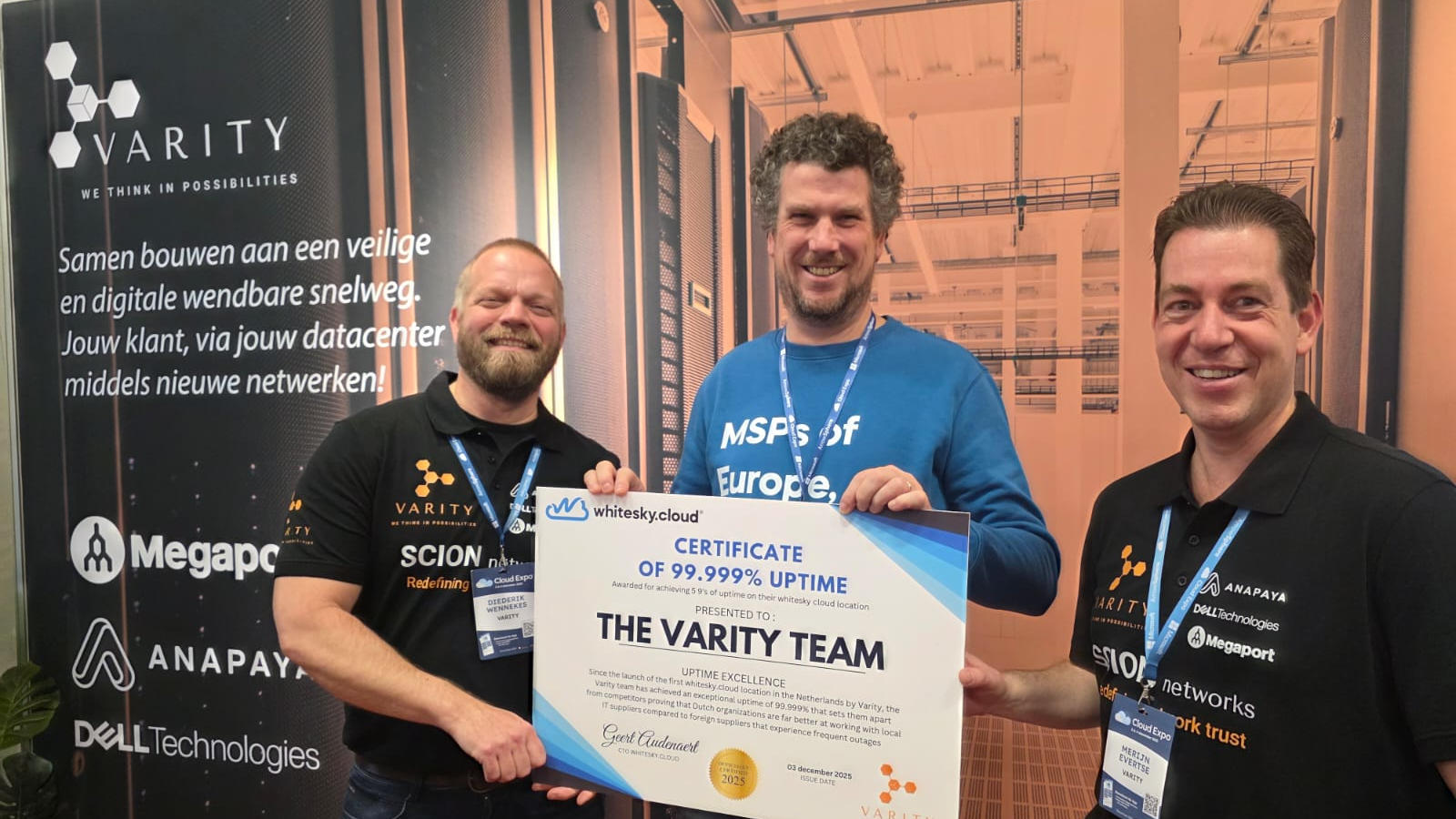
Dutch Sovereign Cloud Platform Reaches 99.999% Uptime
December 3, 2025
Varity and whitesky.cloud jointly demonstrate that American hyperscalers are not required for …
The VMware Reset: Europe Reclaims Control of Its Cloud Stack
November 12, 2025
A new research report sponsored by Veeam and published by Foundry reveals what many IT leaders …